Jewel and her JV team are champs. An undefeated middle school season. The joy always spilled out when a basket was made. The gift of a good team is always mutual encouragement. We loved cheering them on. All kids are our kids.

Jewel and her JV team are champs. An undefeated middle school season. The joy always spilled out when a basket was made. The gift of a good team is always mutual encouragement. We loved cheering them on. All kids are our kids.

It always begins with a story we tell ourselves.
A story where “they” are not worthy of being treated with human dignity, where whole lives are flattened into headlines, where mothers and fathers become statistics, where children become shadows at the edge of a slogan.
We call them criminals.
We call them invaders.
We call them “the worst of the worst,”
as if they are all evil.
Dehumanization is never loud at first.
It arrives dressed as concern.
As “law and order.”
As reason.
As protection.
As common sense.
It asks us only to believe the worst about someone else, and promises it will benefit us and won’t cost us anything.
But it always does.
Because the moment we accept a lie about another person’s humanity, we loosen our grip on our own.
We begin to tolerate cages we would never enter, violence we would never excuse, and cruelty we would never survive.
We learn to look away.
And looking away reshapes us.
Once a group of people becomes a threat instead of a neighbor, anything can be done to them.
Their families can be torn apart.
Their bodies can be abused.
Their suffering can be explained away as necessary, unfortunate, but deserved.
History teaches this lesson again and again,
not in whispers, but in mass camps turned into museums, mass graves with monuments, and apologies written too late.
And still we say, this time is different.
It never is.
What dehumanization does most effectively
is not just harm its targets, it hollows out the soul of those who participate.
It trains us to distrust compassion.
To sneer at mercy.
To call empathy weakness.
To mistake dominance for strength.
It teaches us to survive by shrinking our moral imagination until only people like us can fit inside it.
And then we commit the greatest blasphemy of all: we drag God into justify it all.
We quote scripture to justify cruelty.
We baptize policies that break bodies and spirits.
We invoke Jesus while ignoring everything he said, everything he touched, everyone he loved.
The God who knit every human being together,
brown, black, documented, undocumented,
made in the image of divine dignity, is turned into a mascot for fear.
A weapon for exclusion.
A stamp of approval on violence.
We sanctify evil and call it righteousness.
This dehumanized mentality looks at the immigrant, the refugee, the outsider
and sees a problem to be solved.
It looks at someone like Jesus,
beaten by the state, criminalized by religious leaders, executed under the banner of law and order, and says, “He should have just obeyed the law.”
Jesus is always found among the dehumanized.
Not because he failed to rise above them, but because he refused to abandon them.
He is with the caged.
The scapegoated.
The lied-about.
The bodies treated as disposable.
So when we Christians participate in this dehumanization, when we strip others of their humanity, we also strip Jesus of his humanity,
denying that he would suffer where others suffer.
And then we strip him of his divinity,
by reshaping God into our own fearful image.
When we erase the humanity of others,
we erase our own reflection in the mirror of God.
A society cannot survive this forever.
A church cannot survive this at all.
Because the gospel does not begin with borders,
but with God and humanity.
It does not begin with exclusion, but incarnation.
God does not save us from a distance.
God becomes one of us.
And any faith that requires us to believe the worst about our neighbors
is not forming saints,
it is forming tyrants,
it is training us to forget who we are.
When we dehumanize others,
we don’t just harm them.
We become something less than human ourselves.
We must regain the story of our shared humanity.
Benjamin cremer

If you want to identify me,
ask me not where I live,
or what I like to eat,
or how I comb my hair,
but ask me what I am living for,
in detail, ask me what I think
is keeping me from living fully
for the thing I want to live for.
+ Thomas Merton
Blessed this afternoon to sit court side at the UW basketball game. A friend shared their tickets and our family enjoyed the gift. A treasure to do right here in our backyard. Nothing better than seeing people live their passion and share their talents with others. Some good inspiration was deposited in our young ones as they dream dreams for their own lives.






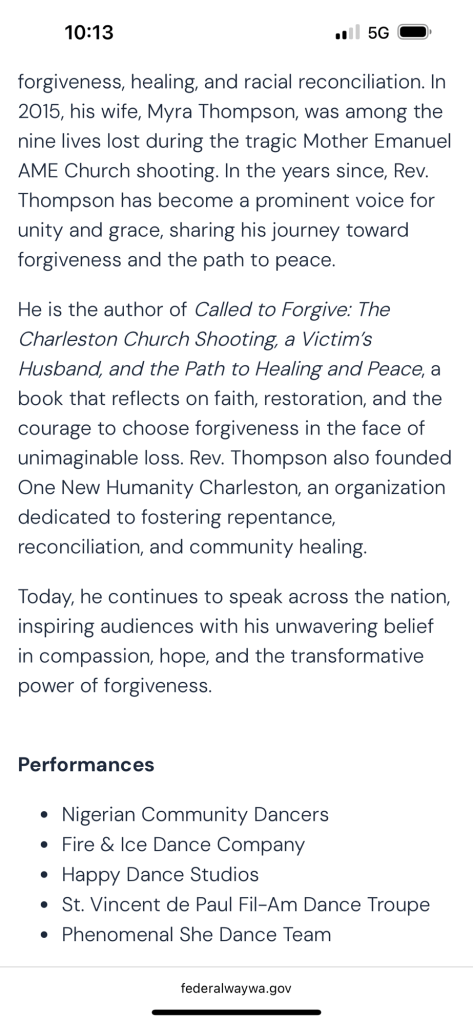
Our family was honored to join our community for the 2026 MLK Day Celebration at the Performing Arts and Event Center, hosted in partnership with the Federal Way Diversity Commission.
Reverend Anthony Thompson delivered a powerful keynote on hope, forgiveness, and healing, and the event was enriched by performances from local culturally diverse groups.
Every day as a person of faith and as a citizen of this country and world is a day to honor Dr. King’s legacy through unity and action.







“Little Dog’s Rhapsody in the Night”
He puts his cheek against mine
and makes small, expressive sounds.
And when I’m awake, or awake enough
he turns upside down, his four paws
in the air
and his eyes dark and fervent.
“Tell me you love me,” he says.
“Tell me again.”
Could there be a sweeter arrangement? Over and over
he gets to ask.
I get to tell.
+ Mary Oliver
Scripture — Colossians 1:3-6 (NRSV)
In our prayers for you we always thank God, the Father of our Lord Jesus Christ, for we have heard of your faith in Christ Jesus and of the love that you have for all the saints, because of the hope laid up for you in heaven. You have heard of this hope before in the word of the truth, the gospel that has come to you. Just as it is bearing fruit and growing in the whole world, so it has been bearing fruit among yourselves from the day you heard it and truly comprehended the grace of God.
Focus If you want to flourish in life, let the good news of God’s grace in Christ be the center, foundation, and motivation of all that you do. Our fruitfulness is a result of the gospel living in us, shaping our thinking, feeling, and acting. When we bear fruit, God is glorified, to be sure (John 15:8). But the source of our fruitfulness isn’t our brilliance, cleverness, hard work, or even faithfulness. Rather, we are fruitful when God’s grace in Christ transforms us from the inside out.
Take a moment to reflect on this story that leads to #flourishwithhumanity:
At 2:48 AM last Tuesday, the most important man in the county took his final breath. He didn’t pass away in a luxury estate; he died on the cold, polished linoleum of Oak Ridge High, right in the middle of Hallway D, next to a buzzing snack machine.
For five hours, he lay there unnoticed. The industrial floor buffer he had been using was still humming, spinning in steady, lonely circles against a row of lockers, filling the corridor with the scent of floor wax and burnt rubber.
His name was Arthur Vance. He was 76.
To the school administration, he was merely Employee #812—a budget line item they frequently considered cutting to save money. To the teachers, he was the silent figure in the gray jumpsuit who cleared the bins after the lights went out. To the students, he was just “Old Artie,” the man with the slow gait who hummed old jazz tunes while mopping up spilled soda.
The medical report said “Cardiac Failure.” The police called it “Natural Causes.” But if you had stood in the freezing drizzle outside the chapel yesterday, watching nearly seven hundred people—teenagers, parents, and laborers—crowd the sidewalks, you would have heard the real story.
Arthur didn’t die because his heart failed; he died because his heart was too big for one man to carry.
The Revelation
On Wednesday, Principal Sterling called a mandatory assembly. The atmosphere was stiff and routine. The goal was simple: announce the death, offer a moment of silence, and get everyone back to class.
“Students,” Sterling said, “we are saddened to share that our night custodian, Mr. Vance, passed away on-site. We appreciate his years of service. Ten seconds of silence, please.”
The gym went quiet—that hollow silence of shifting feet and rattling vents. Then, from the very top of the bleachers, a heavy chair scraped against the wood.
Caleb, the star quarterback—6’4” and destined for a D1 scholarship—stood up. Tears were streaming down his face. “He wasn’t just the janitor,” Caleb’s voice boomed, cracking with emotion. “Mr. Artie taught me Calculus.”
The faculty looked on in total confusion. Artie pushed a broom. He didn’t do advanced math.
“I was going to lose my eligibility,” Caleb yelled, wiping his eyes. “My family was hit hard last year; we couldn’t afford a tutor. I was failing. I was sitting in the dugout at 9 PM one night, crying because I thought my future was gone. Mr. Artie came by with his mop. He didn’t judge. He sat down and stayed until midnight. He told me he used to be a civil engineer before he retired. He explained limits and derivatives better than any textbook. He’s the reason I’m graduating.”
Before the Principal could speak, a girl named Elena stood up. She was the quiet student who usually hid in the back of the library. “He fed me,” she whispered.
She turned to the crowd. “My dad’s been out of work. The fridge is usually empty. I stopped eating lunch so my little brother could have my share. Mr. Artie caught me drinking water from the sink to dull the hunger pangs. The next day, he gave me a grocery gift card. He told me he ‘won it in a contest.’ He refilled it every single week. He told me, ‘You can’t build a brain on an empty stomach, kid.’”
Then, more students stood. Dozens of them.
“He fixed my winter coat with a heavy-duty stapler and tape because I didn’t have one.”
“He walked me to the bus stop every night after drama club because he knew I was scared of the dark.”
“He listened to me when I felt like ending it all. He sat with me in the boiler room and told me stories until the sun came up. He saved my life.”
The Hidden Sanctuary
After the assembly, the staff went to open Artie’s locker—a tiny, cramped space in the basement. They expected to find old rags and soap. Instead, they found a sanctuary.
It was a hidden supply closet. Shelves were lined with granola bars, hygiene products, and thrift-store sweaters for kids who came to school cold. There was a stack of SAT prep guides, heavily annotated.
And there was a notebook. A simple, battered spiral-bound log:
“Nov 12: Marcus needs a new pair of size 12 shoes. Check the surplus store.”
“Nov 20: Chloe seems depressed. Parents fighting? Check in on her tonight.”
“Dec 5: Caleb is mastering the equations. He needs a win. Tell him he’s a leader.”
Artie saw everything. In a world of distracted scrolling, he was watching the people. He saw the cracks where children were falling through, and he quietly spent his life filling them.
The Legacy
The funeral was massive. Artie’s daughter, Sandra, flew in from the city. She was a corporate executive who hadn’t seen her father in years. She told the director she expected maybe five people. She thought her father was a “distant man” who preferred his mop to his family.
“I never understood why he chose this,” she said. “I thought he had just given up.”
Then she saw the line of cars stretching for miles. She saw the police escort. She saw hundreds of students holding candles in the rain.
A man in a suit approached her. “I’m from the Class of ’98,” he said. “Your dad caught me stealing from the cafeteria. Instead of calling the cops, he bought me a meal and asked what was wrong. I’m a judge now because of him.”
Sandra collapsed into the arms of the students. “I didn’t know,” she sobbed. “I thought he was just a janitor.”
“He wasn’t a janitor,” Caleb said gently. “He was the soul of this school.”
The Truth
Arthur Vance saved lives. He mended spirits and fed bodies. He gave every cent of his pension and every hour of his rest to children who weren’t his own.
And yet, he died alone. He fell at 2:48 AM, and for hours, no one knew. The man who watched over everyone had no one watching over him.
The students now visit his grave in shifts. They leave report cards, flowers, and granola bars. One note, taped to his stone, reads: “You saw us when we were invisible. We see you now, Artie. Rest easy.”
Don’t wait for a funeral to see the “invisibles” in your life. Look up from your phone. See the lady at the register, the man collecting carts, the neighbor who waves. Our society is held together by people like Artie.
Let everyone know that they are seen and loved.
A Daily Blessing
May your hands, this day, learn the grace of holding—
May your ears, this day, receive the courage of listening—
May your eyes, this day, awaken to wonder—
May your feet, this day, walk The Way—
And may your whole being, this day—
every breath, every bone, every bright imagination—
remember what you were made for:
to love and to be loved.
Go in the grace that goes before you,
walk in the love that walks with you,
and rest in the mercy that rests upon you. Amen.


I will always get a kick out of the mid-winter blooms that take place in our yard. I cannot figure out the how or the why but they do what they do regardless of the cold temps.
Winter – spring – summer – fall – blooms abound in the coastal pnw. I am grateful.
The sisters go back to school after a good Christmas Break. On the 12th day of Christmas – the Day of Epiphany – the school year takes off again. School – basketball – track – band – and all academics keep the wheels turning. May 2026 be a blessed year for the kiddos.



THE YEAR AS A HOUSE
Think of the year
as a house:
door flung wide
in welcome,
threshold swept
and waiting,
a graced spaciousness
opening and offering itself
to you.
Let it be blessed
in every room.
Let it be hallowed
in every corner.
Let every nook
be a refuge
and every object
set to holy use.
Let it be here
that safety will rest.
Let it be here
that health will make its home.
Let it be here
that peace will show its face.
Let it be here
that love will find its way.
Here
let the weary come
let the aching come
let the lost come
let the sorrowing come.
Here
let them find their rest
and let them find their soothing
and let them find their place
and let them find their delight.
And may it be
in this house of a year
that the seasons will spin in beauty,
and may it be
in these turning days
that time will spiral with joy.
And may it be
that its rooms will fill
with ordinary grace
and light spill from every window
to welcome the stranger home.
—Jan Richardson
from How the Stars Get in Your Bones: A Book of Blessings
janrichardson.com/books
 Johnson 2025 Sabbatical